
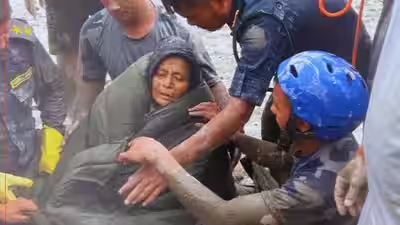

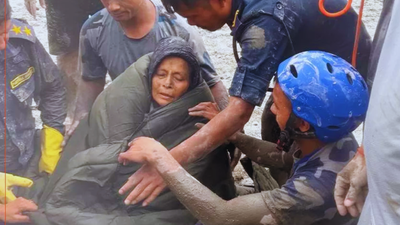
For eight days, Chandrika Shrestha’s family searched for her after a devastating flood swept through Nepal’s Bhotekoshi river basin. There was no sign of the 64-year-old woman. Her house had been carried away and the search had become increasingly difficult. The family eventually accepted that she was probably dead. They made an effigy from kusha grass and began performing funeral rituals for her in Kathmandu. Then, on the 11th day, rescuers heard a faint voice coming from beneath the debris of a house in Betrawati. It was Chandrika.According to the Statesman and various local media from Nepal, the 64-year-old was found alive, partly trapped in mud on the fourth floor of a house that had been buried by the August 26 floods. She was rescued by an Armed Police Force team and taken by helicopter for medical treatment.
The search had already ended
Chandrika lived in Betrawati in Nuwakot’s Bidur Municipality-10. When the floods struck on August 26, she was inside her home with her husband. According to the Indian Express and media reports, the force of the water lifted and swept away their four-and-a-half-storey house. The structure eventually became lodged along the bank of the Trishuli River.Her family searched for eight days. Her son-in-law also spent two to three days looking along the banks of the Betrabati and Trishuli rivers. But the terrain was becoming almost impossible to navigate. Deep mud and swampy ground made it difficult even for rescuers to reach some areas. The bodies had begun decomposing in the area, making the search even harder. After days of looking without finding her, the family decided there was little chance that Chandrika was still alive.They began funeral rituals at their home in Kathmandu’s Sano Bharyang, using a body made from kusha grass in place of her remains. But one member of the family was still not completely convinced. Ramesh Man Shrestha, Chandrika’s samdhi, told The Statesman that he wondered whether she could have survived somewhere inside the house.“If she was at home, I thought she might be upstairs,” he said.
Then rescuers heard a voice
The breakthrough came on the 11th day. According to The Indian Express, an Armed Police Force team had been sent to the area for road-related work when its members heard faint cries near the buried house. They began removing mud and debris by hand. The team eventually broke through a window and reached Chandrika.Chandrika was found in a semi-conscious condition. Much of the house had been buried, but part of the upper floor remained accessible. The Indian Express reported that the floodwaters had shifted the structure roughly 100 metres and buried around three and a half storeys, leaving part of the top floor clear.She was given initial treatment before being flown by helicopter to the Nepal Army’s Maithili Barracks in Trishuli. She was later taken to the Army Hospital in Chhauni, Kathmandu.
Her family learnt about the rescue by phone
The news reached Chandrika’s family through her daughter. Ramesh immediately rushed to the hospital after receiving the news. He was not initially allowed to meet Chandrika directly, as doctors had asked the family to wait for 72 hours before visiting her. Her grandson also came to the hospital.Ramesh said that the boy had been crying continuously and had barely eaten after learning that his grandmother had been found alive. He had reportedly spent the previous day singing prayers. For the family, the news came after days of searching, mourning and performing rituals for a woman they believed they had lost.
Chandrika’s survival comes amid a massive rescue operation
Her rescue was one of several recent breakthroughs in Nepal’s flood-hit areas. The Indian Express reported that a Chinese national, Lu Haitao, was also rescued from about 225 metres inside a tunnel at the Upper Trishuli-I Hydropower Project in Rasuwa. Two other workers had been rescued from another hydropower tunnel a day earlier. The wider disaster began on August 26, when flash floods struck the Bhotekoshi river basin and devastated settlements and infrastructure across affected parts of Nepal.